
Professional Commercial Cleaning Cambridge, Cambridgeshire

Most commercial cleaning is judged on the walkthrough - whether the obvious surfaces look right when someone's watching. The real test is what's still true an hour later, with nobody checking.
Crispin Cleaners built its approach to commercial cleaning in Cambridge on ten years of experience across offices, hospitals, healthcare facilities and laboratories - including plenty of sites where the standard had already slipped and needed rebuilding from the ground up.
That's where The Xtouch Experience comes from: one question, asked at the door on the way out, every single time. From office and corporate cleaning to schools, laboratories and commercial property, here's what actually goes into keeping a Cambridge workplace spotless - without anyone having to supervise it.
Crispin Cleaners is a Cambridge-based cleaning company providing commercial cleaning across Cambridge, Cambridgeshire and Suffolk. We work in offices, corporate premises, schools, healthcare environments, laboratories, shared commercial buildings and properties coming out of construction or refurbishment. Work is arranged as a recurring schedule, as a one-off clean, or as periodic deep cleaning that sits alongside routine visits.
We are built on more than ten years of hands-on cleaning experience across private homes, offices, hospitals, healthcare facilities, laboratories, commercial buildings and shared spaces. A large part of that experience involved being sent to sites where standards had already slipped, or where a complaint had been raised and the standard had to be brought back. That is a particular kind of training.
It teaches you what gets missed, which areas a client notices first, and why cleaning fails on some sites and holds on others.
That experience shapes how we approach commercial work today. The measure we use is the question behind The Xtouch Experience: how clean is it when I leave? The commercial version of that promise is simple. A business should be able to stop checking.
Commercial Cleaning in Cambridge
Commercial cleaning is the cleaning of premises used for business, education, healthcare, research or public access, carried out to an agreed scope and frequency so that the premises stay presentable, hygienic and fit for use between visits.
In practice, it covers several different kinds of work:
- Recurring cleaning. A defined set of tasks carried out daily, several times a week, weekly or fortnightly.
- Periodic cleaning. Tasks that do not need doing every visit, such as carpet washing, internal glass, high dusting or detailed washroom work, scheduled at intervals.
- One-off cleaning. A single visit for a specific reason, such as opening a new premises, recovering a neglected site or preparing for a handover.
- Deep cleaning. A detailed clean that reaches surfaces and areas routine cleaning does not touch.
A Cambridge business might need only one of these. More often the right arrangement is a routine schedule with periodic work built into it, so the building does not slowly drift downwards over a year of visits that only ever cover the same visible surfaces.
Request a Free Commercial Cleaning Quote
How Commercial Cleaning Differs From Domestic Cleaning

The tasks overlap. The operating conditions do not.
A commercial site has traffic. Dozens or hundreds of people use the same door handles, washrooms, kettle and carpet every day. Soil arrives faster and concentrates in predictable places. Entrance matting, lift lobbies, stair edges, desk zones and washroom floors wear at a different rate from the rest of the building, and a schedule that treats every room equally will fail in those areas first.
A commercial site has stakeholders. A client forms a judgement on reception in seconds. Staff who find the kitchen sink full or the washroom out of paper raise it with the office manager, who then spends time on cleaning instead of their own job. Reducing that management burden is part of the service.
A commercial site has rules: access times, alarm codes, door entry systems, restricted rooms, confidentiality around desks and documents, waste segregation, and what may or may not be touched. These are agreed and followed rather than worked out visit by visit.
Commercial cleaning is also judged on consistency. A single excellent clean is of limited value to a business. What matters is whether the standard is the same on a wet Friday in February as it was during the first week.
Occupied and Unoccupied Premises
In an occupied workplace, the cleaner works around people: controlling noise, keeping walkways clear, managing wet floors and signage, respecting desks and paperwork, and staying unobtrusive. Vacuuming an open-plan floor at eleven in the morning is rarely welcome, which is one of the main reasons commercial cleaning moves to early mornings or evenings.
An unoccupied building allows a more thorough approach. Furniture can be moved, floors can be taken properly, machinery can be used, and areas can be taken out of use while they dry. Voids between tenants, sites after building work and buildings closed for a holiday period are all opportunities for work that is impractical during business hours.
Commercial Cleaning Services
Crispin Cleaners supports the following commercial environments in Cambridge and Cambridgeshire. The exact scope for any site is agreed before work starts.
Office Cleaning Cambridge
Office cleaning is the core of most commercial contracts. A properly scoped office clean covers:
- Desks and work areas. Clearing waste, wiping clear surfaces, attention to desk edges, monitor stands and pedestal tops. Where desks carry paperwork, the agreement is normally to clean around items rather than move them.
- Reception and entrance areas. These set the impression of the business. Glass, matting, seating, reception counter, floors and the first three metres inside the door deserve more attention than their floor area suggests.
- Meeting rooms. Tables, chairs, glass partitions, whiteboard ledges, remotes and switches, plus resetting the room so it is presentable for the next booking.
- Communal and circulation areas. Corridors, stairs, lift interiors, breakout seating and shared print areas.
- Floors. Vacuuming of carpet and soft flooring, mopping of hard floors, with attention to edges, corners and under furniture where access allows.
- High-touch surfaces. Door handles, push plates, light switches, handrails, lift buttons, shared equipment and shared appliance controls. These are small in area and high in significance.
- Waste. Emptying bins, replacing liners, and moving waste to the agreed collection point. Where a site separates recycling, the cleaning routine needs to respect that rather than merge it.
Office cleaning in Cambridge covers a wide range of building types, from converted period premises in the centre to modern open-plan units on the business parks around the city. Layout, flooring, occupancy and building age all change what the schedule should look like.
Corporate Cleaning
Corporate premises usually ask for more than the basic routine. The distinction is presentation standard and discretion.
That can mean glass and partitions kept to a visible standard rather than cleaned occasionally, boardrooms reset to a fixed presentation before the working day, front-of-house areas checked rather than assumed, and cleaning staff who understand that confidential paperwork, screens and meeting rooms are not to be disturbed. It usually also means a tightly defined access window, because cleaning presence during client hours is not wanted.
Corporate work carries a higher expectation around reporting: if a light is out, a tap is dripping or a washroom is running low, the client wants to be told rather than to discover it.
Workplace Cleaning
Workplace cleaning takes place around normal business activity. Warehouses with office sections, studios, clinics with waiting areas, showrooms, trade counters and mixed-use premises all fall into this category.
The practical considerations are access and interruption: which areas can be cleaned at which times, what must be done before opening, what can be done during quiet periods, and where the cleaner should not be while customers are present. A workplace schedule is built around the rhythm of the business rather than the convenience of the cleaner.
School Cleaning
Educational premises have their own pattern. Use is intense and concentrated into short periods, then the site empties. That means heavy soiling during term time, with useful windows during evenings, weekends and holidays for work that cannot be done with pupils on site.
The areas that matter most in schools are the highest-contact and highest-footfall ones: washrooms, dining and food areas, corridors, entrance matting, door furniture, handrails and shared equipment.
Classroom cleaning has to work around displays, equipment and stored materials, so the scope needs to be explicit about what is cleaned and what is left.
Site access in education is controlled, and any cleaning arrangement has to fit the school's own policies on visitors, supervision and safeguarding. We work to those policies. We make no claims about clearance or approvals beyond what has been arranged with the individual site.
Healthcare Cleaning
This is an area where our experience is directly relevant. Our founder's ten years of cleaning include hospitals and healthcare facilities, which are environments where the cleaning method matters as much as the result.
Healthcare cleaning is process-led. The things that separate it from general commercial cleaning include:
- Sequence. Cleaning moves from cleaner areas to dirtier areas, and from higher surfaces to lower ones, so that soil is not spread backwards through a space.
- Separation of equipment. Cloths, mops and equipment are kept separate between area types rather than carried from one room to the next.
- Coverage of touch points. In a clinical or care environment, handles, rails, switches, bed frames, chair arms and shared surfaces carry more weight than open floor space.
- Consistency. A standard that is met on some visits and missed on others is not an acceptable standard in a healthcare setting.
- Discretion. Patients, service users and visitors are present. Working quietly and respectfully is part of the job.
Crispin Cleaners can support healthcare premises such as clinics, practices, care environments and treatment rooms, with the scope agreed on a site-by-site basis. We work to the client's own cleaning policies and infection-control requirements where they exist. We do not claim NHS approval, infection-control certification or clinical specialist status. Where a site requires specific accreditation or a specific clinical cleaning protocol, that should be raised at enquiry stage so the requirement can be assessed honestly before any commitment is made.
Laboratory Cleaning
Laboratory experience is part of the same background. Cambridge and the surrounding science parks contain a high concentration of research and laboratory premises, and cleaning them is a controlled activity rather than a general one.
Laboratories differ from ordinary commercial premises in several ways:
- Defined zones. Some areas are cleaned by cleaning staff, some are cleaned only by laboratory staff, and some are not to be entered at all. Knowing and respecting that boundary is the single most important part of the job.
- Contamination control. Work needs to avoid moving material between areas, and avoid disturbing samples, equipment or experiments in progress.
Surfaces and equipment. Benching, fume cupboard exteriors, equipment housings and instrument surfaces often have specific instructions attached, including materials that must not be used on them. - Do not touch rules. Equipment, containers, waste streams and labelled items are left alone unless the site has explicitly included them in scope.
- Access and timing. Laboratory work runs on its own schedule, and cleaning has to be timed around it.
What we offer laboratories in Cambridgeshire is familiarity with that way of working: cleaning to a site's written procedure, staying inside the defined scope, and not improvising. The scope of any laboratory clean is agreed with the site before work begins. We do not claim to be able to clean every category of laboratory, and we hold no laboratory-specific certifications.
Request a Free Commercial Cleaning Quote
Commercial Property Cleaning

For landlords, managing agents and property managers, cleaning is about the presentation of the asset.
This typically covers common parts rather than tenant demises: entrance lobbies, stairwells, lift interiors and lift tracks, corridors, shared washrooms, bin stores, internal glass and shared kitchens. It also covers the presentation of vacant units between tenancies, where a clean unit shows better and lets faster.
Multi-tenant buildings bring their own considerations. Cleaning has to happen without disturbing individual tenants, access has to work through a single agreed arrangement, and standards have to be visible enough that tenants stop raising issues with the managing agent. Where a building changes hands, changes tenant or has been neglected, a recovery clean followed by a routine schedule is usually more effective than trying to bring the standard up gradually.
Contract Cleaning
Contract cleaning means a recurring cleaning arrangement carried out to an agreed written scope, at an agreed frequency, on an ongoing basis.
A generic recurring arrangement is loosely defined. A cleaner attends twice a week and does what seems necessary. It works while the cleaner is good and attentive, and it degrades quietly when they are busy, rushed or replaced, because nobody can say precisely what was supposed to happen.
A properly defined commercial cleaning schedule is different in structure. It states:
- Scope. Which areas are included, and which are not.
- Tasks per area. What is done in each area on each visit.
- Frequency per task. Daily, per visit, weekly, monthly or quarterly. Not every task needs to happen every time, and saying so openly is more honest than implying everything is done constantly.
- Periodic work. Carpet washing, high dusting, internal glass, detailed washroom work and floor treatments, scheduled rather than left to chance.
- Access arrangements. Times, keys or codes, alarm procedures, and who to contact.
- Exclusions. Anything specifically outside the scope, so there is no ambiguity later.
- Review. A point at which the arrangement is looked at again, because buildings change. Occupancy grows, a floor is taken on, a room changes use, and the schedule should move with it.
- Written scope protects both sides. The client knows what they are paying for. We know what we are accountable for. Disputes in commercial cleaning almost always come from a gap between what was assumed and what was agreed.
Crispin Cleaners agrees scope, frequency and access arrangements with each commercial client before work begins. Specific terms, notice periods and service levels are set out at quotation stage for the individual site.
One-Off Commercial Cleaning
Not every commercial requirement is ongoing. Common reasons a Cambridge business books a single clean include:
- Preparing new premises for opening. A unit is rarely handed over clean, and the first impression of a new site matters.
- After an event. Conferences, open days, launches and staff events leave a building that needs resetting.
- After building work. Covered in more detail below.
- Before or after occupancy. A tenant leaving, a tenant arriving, or a unit going on the market.
- Recovering a neglected space. Where cleaning has lapsed, the building needs bringing back to a baseline before any routine schedule can realistically hold it.
- Periodic deep cleaning. Once or twice a year alongside an in-house or existing arrangement.
- Preparing for inspection or handover. Where the premises will be assessed by a third party.
A one-off clean is quoted on the actual condition and size of the premises. It is also a reasonable way for a business to see how we work before considering anything recurring.
Deep Commercial Cleaning
Deep cleaning reaches the areas that routine cleaning does not.
Routine cleaning is designed to maintain a standard efficiently within a limited time window. That means it concentrates on visible surfaces, high-traffic areas and touch points. Over months, soil accumulates in the places outside that pattern: skirtings, chair and desk legs, radiator surrounds, vents and grilles, the tops of partitions and cupboards, light fittings, internal glass and frames, behind and beneath fixed furniture, kitchen appliance interiors and detail, washroom grout and pipework, and carpet that has been vacuumed but never washed.
Deep cleaning also addresses fabric rather than only surfaces. Carpet washing, hard floor treatment, upholstered seating and detailed washroom work all belong in this category.
There is no universal deep-clean checklist that suits every building, and a provider offering one is describing a product rather than a solution. The scope depends on:
- the size and layout of the premises
- the current condition
- how the building is used and how heavily
- occupancy, and whether areas can be taken out of use
- the surfaces and floor types present
- access, including out-of-hours access
- the outcome required, for example presentation for a client visit versus recovery of a neglected site
For that reason, a deep clean is scoped after seeing the premises. Quoting one blind produces either an inflated price or a disappointed client.
Request a Free Commercial Cleaning Quote
Post-Construction and Post-Renovation Cleaning
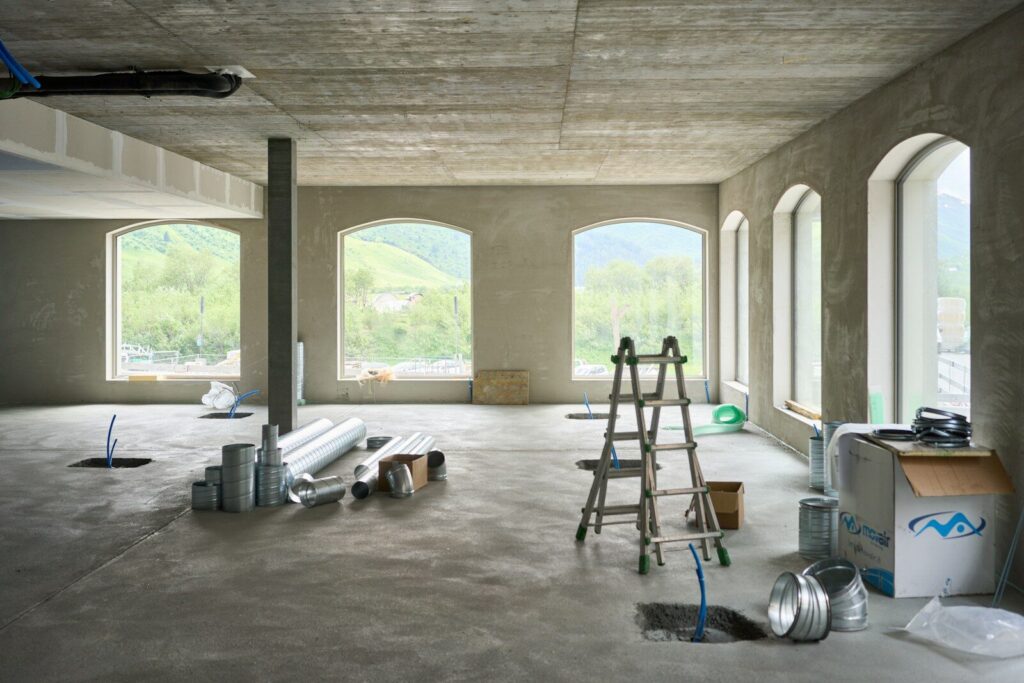
Cleaning after construction, refurbishment, renovation, decorating or installation work is a separate discipline from routine cleaning.
The defining problem is fine dust. Cutting, sanding, drilling and plastering create particles that settle everywhere, including surfaces well away from the work area and surfaces that face upwards out of sight. Dust also continues to fall for some time after the work stops, which is why a single early clean often appears to fail. Sequence matters: high to low, with time allowed for settlement before final surfaces are finished.
Beyond dust, the work usually involves:
- Fine debris. Screws, offcuts, plaster fragments and packaging, including in corners, edges, ducting recesses and window channels.
- Residue. Adhesive, sealant, paint spots, plaster splashes, protective film and sticker residue on glass, frames, ironmongery and sanitary ware.
- Marks. Scuffs and transfer marks on walls, skirtings, doors and floors.
- Floors. New flooring often arrives with a protective coating or installation residue that needs removing correctly for the material.
- Presentation. Internal glass, frames, sanitary ware and ironmongery are what the client inspects on handover.
Crispin Cleaners provides post-construction and post-renovation cleaning for commercial premises. Where a site requires site inductions, specific site rules or contractor arrangements, these are discussed at quotation stage. We hold no construction-sector accreditations and do not claim any.
High-Level Cleaning
High-level cleaning requirements can be discussed as part of a site assessment.
Interior high-level work such as the tops of partitions, cupboards, shelving, ledges, pipework and accessible light fittings can usually be included within a deep clean or periodic schedule where it can be reached safely from the floor or from appropriate low-level access equipment.
Work requiring powered access, scaffolding, rope access or external elevated work is assessed separately and only undertaken where it can be carried out safely and appropriately for the site. We do not claim IPAF, rope access or cherry-picker capability.
Similarly, external window cleaning at height is not a service we currently promote for commercial contracts. Internal glass, low-level external glass and specific requirements should be raised at enquiry so they can be assessed honestly rather than assumed.
Carpet and Upholstery Cleaning
Carpet in a commercial building is the largest soft surface in the premises and the one that ages most visibly.
Three levels of care apply:
- Routine vacuuming. Part of the regular schedule. It removes loose soil and grit, which is the main cause of fibre wear. Vacuuming is the single most valuable thing anyone does for a commercial carpet, and it is most valuable in entrance areas, corridors and beneath desks.
- Spot treatment. Dealing with spills and marks promptly, before they set. Most permanent carpet staining in offices is not caused by the spill. It is caused by the delay.
- Periodic carpet washing. Deep cleaning that removes embedded soil that vacuuming cannot reach. Frequency depends on traffic, entrance arrangements, flooring type and the standard the site wants to hold. Heavy-traffic areas often justify more frequent attention than the rest of the floor plate.
Crispin Cleaners provides carpet washing for commercial premises, either as part of a periodic schedule or as a one-off. The method and drying time depend on the carpet type and the building's occupancy, and are confirmed before the visit so the space can be planned around it.
Upholstery such as reception seating, breakout furniture and meeting-room chairs can be assessed at the same time. Suitability depends on the fabric and its manufacturer guidance, and any upholstery work is confirmed after inspection rather than assumed.
Regular carpet care contributes to two things a business can measure: how the premises present to visitors, and how long the flooring lasts before it needs replacing.
Washroom Cleaning
Washrooms are the part of a commercial building where cleaning standards are judged most harshly. They are also the area where lapses are reported fastest by staff and remembered longest by visitors.
Commercial washroom cleaning typically covers:
- WCs and urinals. Bowl, rim, seat, cistern, flush handles or plates, and the pipework and fixings behind and beneath, which are frequently missed.
- Sinks and taps. Basin, overflow, tap body and base, splashback and the underside of the basin edge.
- Mirrors and glass. Cleaned to a finish without streaking or residue marks, because this is what people look at directly.
- Floors. Including edges, corners and the areas around the base of fittings and behind doors.
- Touch points. Door handles and push plates, cubicle locks and latches, dispenser buttons, light switches, hand dryer casings and taps.
- Dispensers and consumables. Wiping unit exteriors, and restocking soap, paper and liners where consumables are included in the agreed scope.
- Waste. Emptying and relining bins, including sanitary units where a separate collection arrangement is in place.
- Presentation. Leaving the room dry, tidy, with dispensers aligned and stocked.
Frequency is driven by usage rather than by room count. A washroom serving sixty people needs daily attention and often a mid-day check. A washroom serving eight people in a small office may hold well on a two or three times weekly schedule. Where usage is heavy, the workable answer is usually a shorter, more frequent routine rather than a long clean once a week.
We describe washroom cleaning in terms of what is cleaned and how often. We do not make claims about disinfectant efficacy, pathogen reduction percentages or laboratory-tested outcomes.
Kitchen and Staff-Area Cleaning

Staff kitchens and break rooms create more day-to-day friction in an office than any other area, because responsibility for them is shared and therefore unclear.
A defined scope removes the ambiguity. Typical coverage includes:
- worktops, splashbacks and the edges and joins where residue collects
- sinks, taps, plugholes and drainer areas
- exterior of appliances including fridge, microwave, dishwasher, kettle and coffee machine
- appliance interiors where included in the agreed scope, for example fridge and microwave interiors on a periodic basis
- touch points such as handles, switches, dispenser buttons and appliance controls
- tables, chairs and seating areas
- floors, including under and around furniture where access allows
- bins, including relining and the area around the bin, which is often the dirtiest part of the room
- reporting items such as food left beyond an agreed period, where the site has a policy on this
Appliance interiors, crockery and personal items are the areas most often assumed and least often agreed. It is worth settling them at quotation stage.
Commercial kitchens used for food preparation and service are a different category from staff kitchens. Requirements vary substantially with the nature of the premises and can include extraction, catering equipment, food-safety documentation and specific scheduling. Where a site has a commercial kitchen, the requirement should be described at enquiry so it can be assessed properly and scoped or referred honestly.
Cleaning Schedules
Frequency is the decision that determines whether a commercial cleaning arrangement works. It is driven by occupancy, footfall, the type of premises, the standard the business wants to present, and the areas that deteriorate fastest.
Daily Cleaning
Daily cleaning suits premises with high occupancy or public access: busy offices, reception-led premises, schools, clinics, and any site where washrooms and kitchens are used heavily.
The logic of daily cleaning is that certain areas cannot recover if left. Washrooms, kitchens, bins, entrance areas and high-touch surfaces reach an unacceptable state within a day of heavy use, and no amount of extra time later in the week repairs the impression they make in the meantime. A daily schedule is usually shorter per visit and focused on those recovery-critical areas, with wider tasks rotated through the week.
Weekly Cleaning
Weekly or two to three times weekly cleaning suits smaller offices, low-occupancy premises, professional practices with modest footfall, and businesses where staff manage day-to-day tidiness themselves.
It works when the rate of soiling is genuinely low. It is less suited to sites with shared washrooms in constant use, because the gap between visits is the problem rather than the quality of each visit.
Periodic and Scheduled Deep Cleaning
Periodic work is what stops a building declining slowly under a routine schedule.
Tasks suited to a periodic cycle include carpet washing, hard floor treatment, high dusting, internal glass, vents and grilles, detailed washroom work, appliance interiors, and behind and beneath fixed furniture. These are scheduled at set intervals, for example monthly, quarterly or twice yearly, and priced as part of the arrangement rather than appearing as unexpected additions.
Building periodic work into the schedule from the start is better than reacting once a site has visibly dropped.
Request a Free Commercial Cleaning Quote
Out-of-Hours Cleaning
Many commercial premises in Cambridge prefer cleaning outside working hours. The usual timings are early morning before opening, evening after closing, or overnight.
The reasons are practical:
- No disruption. Vacuuming, floor work and washroom cleaning do not interfere with staff, calls, meetings or customers.
- Better results. Areas can be taken out of use, furniture can be moved and floors can dry properly.
- Presentation at the right moment. Cleaning before opening means the building is at its best when the first person arrives, rather than at 6pm after everyone has gone.
- Security and confidentiality. Some businesses prefer cleaning to take place away from client-facing hours.
Out-of-hours work depends on access arrangements being agreed properly: entry method, alarm procedures, lone working considerations, lighting, and a named contact. These are settled before the first visit rather than improvised.
Availability for early morning, evening and weekend work depends on the site and the schedule and is confirmed at quotation. We do not advertise blanket 24/7 availability.
Commercial Cleaning Prices
We do not publish a headline price for commercial cleaning, because a price quoted before seeing the requirement is a guess presented as a figure.
Commercial cleaning cost depends on:
- Size of the premises. Floor area, and the number of separate rooms and floors, which affects time more than area alone does.
- Layout. Open-plan space cleans faster per square metre than the same area divided into cellular offices, corridors and stairs.
- Type of premises. An office, a school, a clinic and a laboratory require different approaches and different amounts of time.
- Condition. A maintained building and a neglected one are not the same job, particularly on a first visit.
- Frequency. Daily visits cost more in total and usually less per visit, because the building never falls far.
- Scope. What is included, and how detailed each task is.
- Washrooms. Number, size, usage level and whether consumables are included.
- Floor types. Carpet, vinyl, tile, wood and stone all take different time and different treatment.
- Occupancy. Whether the work happens around people or in an empty building.
- Access. Timing, entry arrangements, security requirements and parking.
- Specialist requirements. Controlled areas, site inductions, specific procedures or client-specified products.
- One-off versus recurring. A single visit carries its own set-up time. Recurring work is priced across the arrangement.
Hourly rates are commonly quoted in this industry, and they have a clear limitation. An hourly rate prices attendance rather than outcome. Two providers quoting the same rate may deliver very different amounts of work in that hour, and neither the client nor the provider can say whether the building will be clean at the end of it. An hourly figure also gives a business no way to judge whether the time is sufficient for the premises in the first place.
Our approach is to establish the scope and the standard, work out what that genuinely requires on that site, and quote against it. That gives a figure that can be compared meaningfully with other quotations, and a scope that can be held to.
How Quotations Work
Initial enquiry. You tell us the type of premises, the location, roughly the size, and what has prompted the enquiry. That is enough to establish whether we are the right fit before anyone's time is spent.
Understanding the premises. Where practical we visit the site. Seeing the building shows layout, condition, flooring, washroom provision and the areas that will need most attention. For straightforward premises this can sometimes be handled remotely with photographs and a floor plan.
Establishing the standard. We ask what the premises need to look like and who judges it. A client-facing office and a back-office unit are held to different standards, and it is better to say so than to assume.
Frequency and schedule. We discuss how often cleaning is needed, at what times, and how the schedule fits the working day. This is where out-of-hours access, key or code arrangements and alarm procedures are covered.
Specialist and additional requirements. Controlled areas, site rules, restricted rooms, consumables, waste arrangements, periodic work such as carpet washing, and anything the site handles differently.
Quotation. You receive a written quotation with the scope, frequency and what is included, set against the price. Anything outside the scope is stated as outside the scope.
Practical arrangements. Before the first visit we confirm access, contacts, start date, and how issues or changes are raised. Then the work starts.
There is no obligation attached to a quotation or a site visit.
Request a Free Commercial Cleaning Quote
Problems Commercial Clients Bring to Us
Most businesses that contact us are not starting from nothing. They already have a cleaning arrangement, and something about it has stopped working.
- The standard is inconsistent. Good weeks and poor weeks, with no way to predict which. Usually a scope or staffing-continuity problem rather than an effort problem.
- Areas are being missed. Often the same ones: skirtings, corners, behind doors, under desks, the pipework behind the WC, the edges of hard floors.
- Somebody has to check the work. An office manager walking the building each morning is a cost the business absorbs without recording it.
- The schedule does not fit the business. Cleaning arriving at the wrong time, or too infrequently for the way the building is used.
- Washrooms let the building down. The highest-scrutiny area given the same time allocation as a store cupboard.
- Shared areas are nobody's responsibility. Kitchens and breakout spaces drifting because they are not explicitly scoped.
- Cleaning disrupts staff, because it happens mid-day when the provider is available.
- Out-of-hours access is difficult to arrange reliably with the current provider.
- A one-off deep clean is needed, usually before an inspection, a client visit, a handover or a reopening.
- The premises have been neglected and need recovering before any routine schedule can hold.
Nearly all of these trace back to the same root cause. The cleaning was never scoped properly, so nobody could say what should have happened, and the standard drifted with nothing to anchor it. Defining scope, frequency and accountability at the start is what prevents the drift.
Areas Covered
Crispin Cleaners is based in Cambridge and provides commercial cleaning throughout the city and across Cambridgeshire and Suffolk.
This includes commercial premises in central Cambridge, the business and science park areas around the city, and the surrounding towns and villages including Histon, Trumpington, Fulbourn, Sawston, Waterbeach, Cambourne and Ely, along with wider Cambridgeshire locations such as St Ives, St Neots, Huntingdon and Royston. In suffolk, we cover Haverhill, Bury St Edmunds and surounding cities.
Availability for a specific site depends on location, the schedule required and the nature of the premises, particularly where early morning or late evening attendance is involved. If your premises are in or near Cambridgeshire, it is worth asking.
The Xtouch
The Xtouch is the standard Crispin Cleaners works to. It is a way of judging cleaning, held by the person doing it.
It is not a product, a machine, a chemical or a patented method. There is no equipment called an Xtouch. Describing it as a technology would misrepresent it.
It came from ten years of walking out of buildings. Private homes, offices, hospitals, healthcare facilities, laboratories, commercial buildings and shared spaces. The founder was often sent to sites where standards had already fallen, or where a complaint had been raised and the standard needed restoring. That work teaches a specific lesson: cleaning fails in predictable places, and it fails because the person doing it stopped looking before they left.
The question that came out of that is the whole of it:
How clean is it when I leave?

Not how clean does it look from the doorway. Not whether the obvious surfaces have been done. Whether the room would hold up to someone walking in and examining it properly, including the areas nobody was going to check.
For a commercial client, that question translates into four practical things:
- Ownership. The cleaner is responsible for the result, not for the attendance.
- Attention to the unseen. The edges, the corners, the backs of fittings, the tops of surfaces, the places that only show up over months of being skipped.
- Consistency. The same standard applied on every visit, because a standard that varies is not a standard.
- No reliance on the client to find faults. It should not be your job to identify what was missed. If a client is producing a snag list for their cleaning provider, the arrangement has already failed.
That is what separates The Xtouch from a promise of quality. Quality is a claim. The Xtouch is a question asked at the door on the way out, every time.
Request a Free Commercial Cleaning Quote
Why Crispin Cleaners
10+ Years Across Different Environments
The strongest evidence we can offer a Cambridge business is the range of environments behind the company.
Ten years of hands-on cleaning across private homes, offices, hospitals, healthcare facilities, laboratories, commercial buildings and shared spaces gives a practical understanding that a single-sector background does not. Healthcare and laboratory work teaches process, sequence, restraint and consistency. Office and commercial building work teaches presentation, traffic patterns, and how to operate around staff and visitors. Domestic and recovery work teaches detail, because a private client inspects a room in a way an office manager rarely has time to. Applying healthcare discipline to an office produces a better office clean.
Being sent repeatedly to sites where standards had slipped shapes the approach further. It gives a working knowledge of how cleaning fails, which is more useful when scoping a contract than a list of tasks.
Spotless Without Supervision
A business should not have to manage its cleaners.
Most office and facilities managers who have dealt with cleaning providers have developed a habit of checking: a walk around in the morning, a look at the washrooms, a note of what was missed, a message to the provider. That habit exists because it has been needed, and it costs time that belongs elsewhere.
We work towards removing the need for it. Scope defined properly at the start so expectations are shared. Consistency visit to visit so the standard is predictable. The Xtouch question asked by the person leaving the building, so problems are caught by us rather than found by you.
We will not claim you will never need to speak to us. Buildings change and occasionally something will be missed. What we will say is that supervision is not the mechanism holding the standard in place, and that when something does go wrong, you raise it once.
Who This Service Suits
Commercial cleaning from Crispin Cleaners may suit:
- offices and business premises in Cambridge and Cambridgeshire
- professional practices including legal, accountancy, consultancy and financial offices
- commercial property managers and managing agents responsible for common parts
- landlords with commercial units, including presentation between tenancies
- schools and educational premises
- healthcare environments such as clinics, practices and care settings
- laboratories and research premises, within an agreed and defined scope
- shared and multi-tenant commercial buildings
- organisations wanting a recurring schedule with periodic deep cleaning built in
- businesses needing a one-off, deep or post-construction clean rather than an ongoing arrangement
Request a Commercial Cleaning Quote
If you are responsible for commercial premises in Cambridge or Cambridgeshire, the next step is a conversation about the building.
Request a Free Commercial Cleaning Quote
Discuss Your Cleaning Requirements
Tell us the type of premises, the location, approximate size and what has prompted the enquiry. Where practical we will arrange to see the site, because a quotation based on the actual premises is worth more than one based on assumptions. You will receive a written quotation setting out the scope, the frequency and what is included.
There is no obligation, and no charge for the assessment or the quotation.
Commercial Cleaning Cambridge: Frequently Asked Questions
What is commercial cleaning?
Commercial cleaning is the cleaning of premises used for business, education, healthcare, research or public access, carried out to an agreed scope and frequency. It covers recurring cleaning of areas such as offices, washrooms, kitchens, floors and high-touch surfaces, as well as periodic and deep cleaning of areas that routine visits do not reach.
What types of commercial premises do you clean?
Crispin Cleaners cleans offices, corporate premises, professional practices, schools and educational sites, healthcare environments, laboratories within an agreed scope, shared and multi-tenant commercial buildings, common parts in managed property, and premises after construction or refurbishment.
Do you provide office cleaning in Cambridge?
Yes. Office cleaning is our core commercial service in Cambridge and Cambridgeshire, covering desks and work areas, reception, meeting rooms, communal areas, staff kitchens, washrooms, floors, high-touch surfaces and waste.
Do you provide contract cleaning?
Yes. We provide recurring commercial cleaning to an agreed written scope and frequency. The scope, tasks, access arrangements and any periodic work are set out before the arrangement begins, and reviewed as the building's requirements change.
Can you provide one-off commercial cleaning?
Yes. One-off cleans are commonly arranged for new premises before opening, after events, after building work, before or after occupancy, ahead of an inspection or handover, and to recover premises where cleaning has lapsed.
Can you provide daily commercial cleaning?
Yes, subject to availability for the site and schedule. Daily cleaning generally suits premises with high occupancy or public access, where washrooms, kitchens, bins and entrance areas need attention every working day.
Can you clean offices outside normal working hours?
Yes, subject to the site and the schedule. Early morning, evening and weekend cleaning is common in commercial work because it avoids disruption and allows a more thorough job. Access, alarm and security arrangements are agreed before the first visit. We do not advertise blanket 24/7 availability.
Do you clean schools?
Yes, we clean schools and educational premises. School cleaning focuses on high-contact and high-footfall areas including washrooms, dining areas, corridors, entrance matting and door furniture, with classroom scope agreed explicitly. We work to the school's own site policies on access, visitors and safeguarding.
Do you have experience cleaning healthcare environments?
Yes. The founder's ten years of cleaning experience includes hospitals and healthcare facilities, environments where sequence, separation of equipment, coverage of touch points and consistency matter as much as the visible result. We work to the client's own cleaning and infection-control policies. We do not claim NHS approval, infection-control certification or clinical specialist status.
Do you have experience cleaning laboratories?
Yes. That experience covers working to defined zones, respecting areas that cleaning staff do not enter, avoiding contamination between areas, and following site-specific procedures for surfaces and equipment. The scope for any laboratory is agreed with the site before work begins. We hold no laboratory-specific certifications and do not claim to clean every category of laboratory.
Can you provide deep commercial cleaning?
Yes, either as a one-off or built into a recurring schedule as periodic work. Deep cleaning covers areas routine visits do not reach, such as skirtings, radiator surrounds, vents and grilles, high surfaces, internal glass, behind fixed furniture, appliance interiors, detailed washroom work and carpet washing. The scope depends on the size, condition, use and surfaces of the premises.
Do you provide post-construction cleaning?
Yes. We provide post-construction and post-renovation cleaning for commercial premises, covering fine dust, debris, adhesive and paint residue, protective film, marks and final presentation of glass, frames, ironmongery and floors. Site rules, inductions and contractor arrangements are discussed at quotation stage. We hold no construction-sector accreditations.
Do you clean carpets in commercial premises?
Yes. We provide commercial carpet washing as a one-off or as scheduled periodic work alongside routine vacuuming and spot treatment. Method and drying time depend on the carpet type and the building's occupancy, and are confirmed before the visit. Upholstery is assessed on fabric type and manufacturer guidance.
How much does commercial cleaning in Cambridge cost?
There is no fixed price. Cost depends on the size and layout of the premises, the type of building, its condition, the frequency, the agreed scope, the number and usage of washrooms, floor types, occupancy, access arrangements and any specialist requirements. We quote against an agreed scope after understanding the premises, rather than issuing a headline hourly or per square metre figure.
Why do you not publish an hourly rate?
An hourly rate prices attendance rather than outcome. Two providers quoting the same rate can deliver very different amounts of work, and an hourly figure gives a business no way to judge whether the time allowed is sufficient for the building. Quoting against a defined scope produces a figure that can be compared meaningfully and held to.
Do you provide cleaning schedules?
Yes. Commercial work is carried out to a site-specific schedule setting out which areas are included, which tasks are carried out in each area, how often each task happens, any periodic work such as carpet washing or high dusting, and the access arrangements. The schedule is reviewed as the premises change.
Can cleaning be arranged around our business hours?
Yes. Cleaning can be scheduled before opening, after closing, overnight or during agreed quiet periods, depending on the site. Timing is one of the things settled during quotation, along with access, alarm procedures and a named site contact.
How do I request a commercial cleaning quotation?
Contact us with the type of premises, the location, approximate size and what has prompted the enquiry. Where practical we will arrange a site visit, then provide a written quotation covering scope, frequency and inclusions. There is no obligation and no charge for the assessment.
Which areas around Cambridge do you cover?
We are based in Cambridge and cover the city and Cambridgeshire, including Histon, Trumpington, Fulbourn, Sawston, Waterbeach, Cambourne, Ely, St Ives, St Neots, Huntingdon and Royston. Availability for a specific site depends on location, the schedule required and the nature of the premises.
What makes Crispin Cleaners different?
The background behind the company. More than ten years of hands-on cleaning across private homes, offices, hospitals, healthcare facilities, laboratories, commercial buildings and shared spaces, including sites where standards had fallen and needed restoring. That experience informs how we scope, schedule and deliver commercial work, and it is the basis of The Xtouch standard.
What is The Xtouch Experience?
The Xtouch is the standard Crispin Cleaners works to, built around one question: how clean is it when I leave? It is a way of judging work rather than a product, machine or method. For commercial clients it means ownership of the result, attention to the areas that are easily skipped, the same standard on every visit, and no reliance on the client to identify what was missed.
What is spotless without supervision?
It is the commercial promise behind The Xtouch. A business should not have to inspect whether basic cleaning has been done. Scope is defined at the start, consistency is maintained visit to visit, and issues are reported to you rather than found by you. Buildings change and occasional issues arise, so we do not claim you will never need to contact us. What we work towards is that supervision is not the thing keeping the standard in place.